Is Your Security Proxy Ready for Post-Quantum TLS?
Modern browsers and large web platforms are already moving TLS key exchange to hybrid post-quantum cryptography. But if your organization uses an inspecting SSE or secure web gateway, the browser does not connect to the website directly. The proxy creates two separate TLS connections, and either one can silently fall back to a classical algorithm.
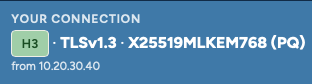
The updated widget on SSE TestCenter now also shows the TLS key-exchange method.
A post-quantum negotiation is marked (PQ); if that label is absent, the
negotiated method is classical. Only (PQ) means that the connection reaching
our server used hybrid post-quantum key exchange designed to resist future quantum
decryption.
Why Protect Traffic Before Quantum Computers Arrive?
An attacker does not need a cryptographically relevant quantum computer today to create a future problem. Encrypted traffic can be copied and stored now, then attacked later if a sufficiently capable quantum computer becomes available. This is commonly called harvest now, decrypt later or store now, decrypt later.
The risk is most important for information that must remain confidential for years: intellectual property, source code, credentials, health and financial data, legal communications, and long-lived personal information. Migrating only after a quantum computer exists would be too late for traffic that has already been recorded.
The information exchanged with SSE TestCenter is not itself sensitive enough to require protection against a harvest-now-decrypt-later attack. The test helps you learn whether you can expect that protection when exchanging confidential data with other websites.
X25519MLKEM768 addresses that risk by combining the established X25519
key exchange with the post-quantum ML-KEM-768 mechanism. It is a hybrid: the resulting
TLS session remains protected as long as at least one of the two components remains
secure. The Internet Engineering Task Force standardized three hybrid groups in this
family in RFC 10024.
SSE TestCenter recognizes all three and displays whichever one is negotiated.
The Browser and Server Ecosystem Is Ready
Post-quantum key agreement is no longer a laboratory-only feature. Since late 2025, current versions of all major browser families support hybrid post-quantum key agreement by default: Chrome and other Chromium-based browsers, Edge, Firefox, and Safari on current Apple operating systems. On the server side, widely used platforms including Cloudflare, Amazon CloudFront, and Google services have deployed hybrid post-quantum TLS support.
This does not mean that every browser version, operating system, website, or TLS endpoint will negotiate it. It means that the normal endpoints on both sides increasingly have the capability, so a classical-only enterprise path is becoming the exception worth finding.
One Browser Visit, Two TLS Connections
TLS inspection changes the meaning of an HTTPS connection. Instead of one TLS session from the browser to the website, the security proxy terminates the browser's session, inspects the traffic, and opens a new session to the origin:
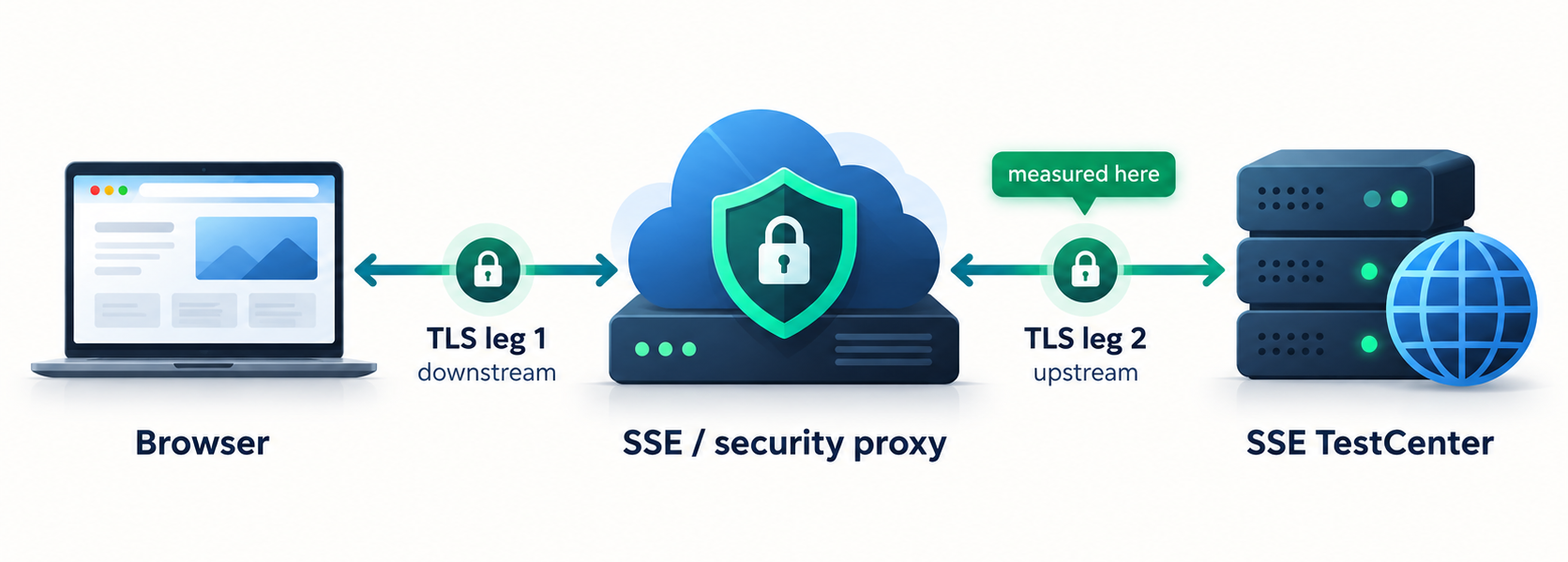
Both legs must negotiate a hybrid post-quantum group to protect the end-to-end path
against later decryption. A PQ-capable browser and a PQ-capable website are not enough if
the proxy uses classical x25519 or secp256r1 on either side.
What the Widget Can/Cannot Tell You
First, know whether your connection is direct or passes through a TLS-inspecting proxy. SSE TestCenter can only report the TLS connection that reaches our server. On a direct connection that is the browser-to-server connection. With TLS inspection it is only the upstream, proxy-to-server leg; the browser-to-proxy leg is not visible to this page.
If the widget shows X25519MLKEM768 (PQ): the connection
reaching SSE TestCenter used hybrid post-quantum key exchange. This says nothing about
the browser-to-proxy leg and does not prove that the proxy supports PQ inspection: it may
be tunnelling or bypassing this site because of a destination, port, or HTTP/3 policy.
If the widget shows a classical group: the connection reaching SSE TestCenter is not PQ-protected. On a direct connection, check the browser, the operating system's TLS stack, and enterprise policy. With TLS inspection, the hidden browser-to-proxy leg could still use PQ, but the result is normally a strong indication that the proxy's server-facing stack, product version, or policy needs attention.
The result is therefore a useful signal, not a complete proof of product support or non-support. Confirm in the gateway logs whether this request was inspected or tunnelled. This differs from a server scanner such as SSL Labs: a scanner shows what a server can support, while SSE TestCenter shows what your actual path negotiated with a known PQ-capable server.
The Product Name Is Not the Deployment Version
Many SSE vendors now document post-quantum capabilities, but the headline does not prove that every installed appliance, cloud tenant, inspection stack, or TLS leg has them enabled. Support can depend on the exact product family, release, rollout channel, tenant setting, operating mode, and destination server.
This creates an uncomfortable inversion of purpose: the security proxy is deployed to protect an organization's most sensitive data, yet an older inspection stack can downgrade an otherwise PQ-capable path and leave recorded traffic vulnerable to a harvest-now-decrypt-later attack.
The following public statements illustrate how different “PQC support” can be from one product and deployment to another. This is not a product ranking or a guarantee about any individual tenant.
Documentation reviewed 12 October 2026. Vendor releases and rollout states change quickly. Corrections and newer public references are welcome at testcenter@cloudfellows.de.
| Vendor / product | Publicly documented scope | Why the exact deployment matters |
|---|---|---|
| Palo Alto Networks Prisma Access |
PQC-ready TLS handling and TLS 1.3 decryption using ML-KEM in Prisma Access 6.1. | The announcement is tied to a named Prisma Access release. An inferred October 2026 observation from a Palo Alto Networks egress used classical secp256r1; the product and release were not independently confirmed. |
| Zscaler ZIA | ZIA inline inspection negotiates a supported hybrid PQ group with PQ-capable clients and offers all standard hybrid PQ key-exchange methods to origin servers. | Zscaler does not name the groups, product version, or rollout state. An inferred October 2026 observation from a Zscaler egress offered only classical NIST curves; it identifies one deployment, not ZIA generally. |
| Cisco Secure Access / Umbrella | No product-specific public statement for hybrid PQ key exchange on the Secure Access TLS-inspection legs was found in the sources reviewed. | In a controlled SSE TestCenter test on 3 October 2026, the server-facing leg negotiated classical x25519. This represents the tested deployment, not every Cisco tenant. |
| iboss | No product-specific public statement for X25519MLKEM768 on the inspected client and origin TLS legs was found in the sources reviewed. |
Ask for the exact platform release, algorithm, enablement state, and support on each proxy leg. |
| Netskope NG-SWG | X25519MLKEM768 on front-end and back-end connections beginning with Release 137. |
Documented as Beta for commercial and compliance environments. Netskope Support enables the front-end and back-end feature flags independently. |
| Fortinet FortiGate | TLS 1.3 hybrid PQ key exchange, including X25519MLKEM768, in SSL deep inspection. |
The documented enhancement is for flow-mode inspection in FortiOS 7.6.5; that scope must not be generalized to older releases or every inspection mode. |
| Skyhigh Security SWG | Cloud SSE enables X25519MLKEM768 by default on the origin leg from SSE 6.8.2; on-premises SWG 13.0 also documents PQ TLS inspection. |
An inferred October 2026 observation suggests that older product generations may not yet support PQ, the exact product and version matters. |
| Cloudflare Gateway | X25519MLKEM768 for the client-to-Gateway leg and the Gateway-to-origin leg. |
— |
| Broadcom SGOS / Edge SWG | Broadcom reports native X25519MLKEM768 support from SGOS 7.4.13.1. |
The cited bug-fix article does not identify the supported inspection legs or state whether PQ is enabled by default. |
| Cato Networks | PQ and hybrid-PQ visibility and enforcement can be configured per TLS-inspection rule, separately for the client and server legs. | PQ is disabled by default and the feature must be enabled through Cato's feature-release process; the public page does not name a specific hybrid group. |
| Check Point Quantum | X25519MLKEM768 support in HTTPS Inspection beginning with R82.10. |
The release notes name the algorithm and release, but do not provide a client-leg/server-leg matrix or state whether PQ negotiation is enabled by default. |
In other words: ask which product, which version, which tenant, which inspection mode, and which leg. A generic “PQC supported” answer is not enough to establish the protection of a particular deployment.
If the Widget Does Not Show PQ
A classical result is not automatically a vulnerability in the sense of a broken or unauthenticated TLS connection. It is a migration finding: this leg does not yet have the protection intended for harvest-now-decrypt-later attacks.
- Confirm in the gateway logs that the request was inspected rather than tunnelled or bypassed.
- Identify the exact SSE/SWG product, software version, inspection mode, and service release used for this traffic.
- Share the result with the vendor and plan the required product upgrade, tenant migration, or feature activation. Then repeat the test.
X25519MLKEM768 is designed to protect key establishment against future quantum decryption;
it does not make every part of today's TLS and public Web PKI post-quantum safe.
Further Reading